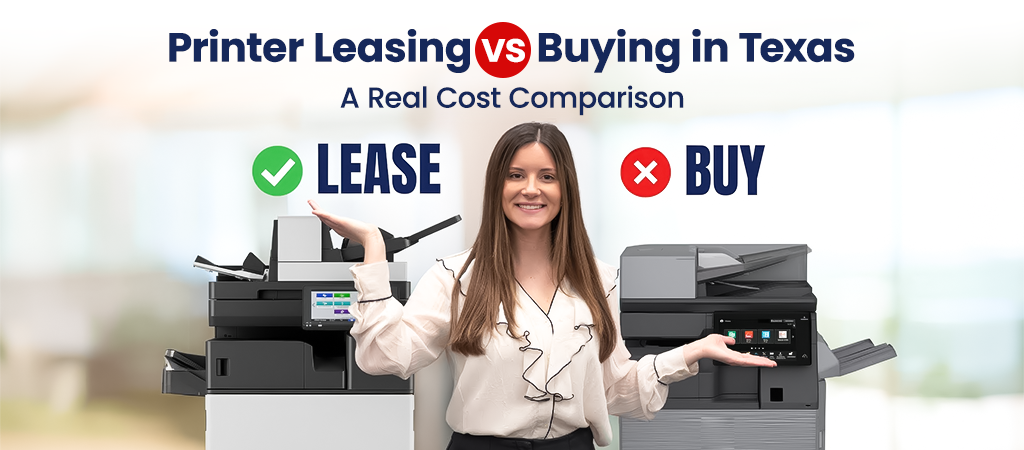
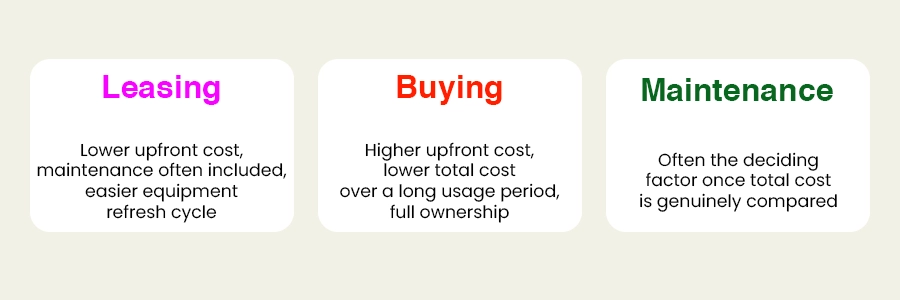
Printer leasing vs buying looks like a simple choice: Leasing looks cheaper month to month. Buying looks cheaper over time. Both impressions are true and incomplete — here’s where leasing actually wins, where buying does, and the maintenance responsibility question that often decides it either way.
The printer leasing vs buying comparison often gets reduced to a simple monthly-cost-versus-total-cost framing, which misses what actually tends to decide it: who’s responsible for maintenance and repairs, and how long the printer is genuinely expected to stay useful for your business. If you’re also weighing support options, our printer support team can explain what each setup involves.
leasing vs buying printer
The Real Comparison in Printer Leasing vs Buying
Factor
Leasing
Buying
Upfront cost
Low — typically no large initial payment
Higher — full purchase price paid upfront or financed
Maintenance responsibility
Often included in the lease agreement
Typically the owner’s responsibility, sometimes covered by a separate service contract
Total cost over 5+ years
Often higher, due to ongoing lease payments
Often lower once the purchase price is fully amortized over a long usage period
Equipment refresh
Easier — upgrade to newer equipment at lease renewal
Requires a separate purchase decision to upgrade
Flexibility to change providers
Often locked into contract terms for the lease duration
Full flexibility — no contract tying you to a specific service provider
Check whether maintenance is genuinely included, and what it actually covers
“Maintenance included” in a lease can range from comprehensive (parts, labor, consumables) to minimal (only certain repairs, consumables billed separately). Before comparing costs, get the specific coverage terms in writing — a lease with limited maintenance coverage may not be meaningfully cheaper than buying with a separate service contract once the gaps are accounted for
When leasing tends to make more sense
In the printer leasing vs buying decision, leasing usually fits when:
You want predictable, budgeted monthly costs: No large upfront capital expenditure, and maintenance costs (if genuinely included) are folded into a predictable payment.
Your needs or volume are likely to change: Leasing makes it easier to upgrade or adjust equipment as your business’s printing needs evolve, without being stuck with owned hardware that no longer fits.
You’d rather not manage maintenance directly: A genuinely comprehensive lease shifts that responsibility to the leasing company, which some businesses value regardless of the cost comparison.
When buying tends to make more sense
In printer leasing vs buying, buying usually fits when:
You expect to use the equipment for a long period without needing an upgrade.
You have (or can arrange) reliable maintenance support separately, like a managed print agreement.
You value full ownership and flexibility over service providers.
The upfront cost is genuinely affordable without straining cash flow.
If you buy, plan for repairs too. A break-fix IT option or a service contract keeps a failed printer from stalling your office.
There can be genuine tax treatment differences between leasing and purchasing equipment — this is worth discussing with an accountant familiar with your specific business structure rather than assuming one approach is universally more tax-advantageous.
Often yes, but usually at a cost specified in the original contract — worth reviewing the buyout terms before signing, not just the standard monthly payment.
Yes — a managed print service agreement covering maintenance and consumables can apply to owned equipment just as it would to a lease, which is part of why the maintenance comparison matters more than the printer leasing vs buying label alone.
Conclusion and Next Steps
Neither option is universally better — the honest comparison depends on your expected usage timeline, how much you value maintenance being handled for you, and your cash flow preferences. In printer leasing vs buying, getting the actual maintenance coverage terms in writing matters more to the real cost than the label suggests. Getting the actual maintenance coverage terms in writing, for either option, matters more to the real cost than the lease-vs-buy label suggests. Need help comparing your quotes? Talk to our IT team and we’ll walk through them with you.