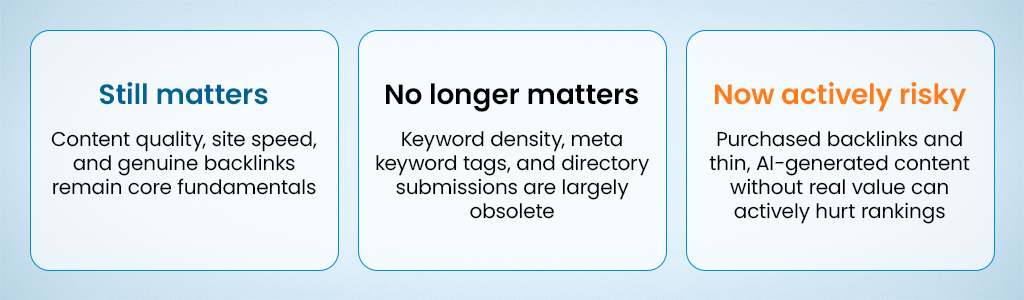
SEO for small business advice from a few years ago is quietly outdated, and a surprising amount never worked the way people assumed. Here’s what genuinely affects rankings today, separated from what’s a myth, a leftover tactic, or simply not worth the effort for most small business sites.
SEO advice ages unevenly. Some fundamentals have stayed genuinely important for over a decade. Other tactics that worked in the past have since become neutral, or actively counterproductive, as search engines have refined how they evaluate sites. Separating the two matters, because time spent on an outdated tactic isn’t just wasted. It can occasionally work against you. Google’s own SEO starter guide is a good baseline for what actually counts.
What Still Matters in SEO for Small Business
If your site is slow or breaks on phones, a web development fix usually delivers more than any new keyword tactic.
Fundamental
Why it still matters
Genuinely useful content
Search engines have gotten measurably better at evaluating whether content actually answers what someone searched for
Site speed
A confirmed ranking factor, and directly affects whether visitors stay or leave
Mobile usability
Most search engines evaluate the mobile version of a site as the primary version for ranking purposes
Genuine backlinks from relevant sites
Still a meaningful trust signal, though quality matters far more than quantity now
Clear site structure and internal linking
Helps both search engines and actual visitors find and understand your content
What no longer matters (or never really did)
Keyword density / stuffing: Repeating a target phrase unnaturally throughout a page hasn’t helped rankings in years, and reads poorly to actual visitors regardless.
Meta keyword tags: Major search engines stopped using this specific HTML tag as a ranking signal a long time ago — it’s essentially inert now.
Mass directory or link farm submissions: This tactic went from mildly helpful to actively risky as search engines got better at identifying low-quality link patterns.
Purchased backlinks: Detectable and against most search engines’ guidelines — the risk of a penalty generally outweighs any short-term benefit. See Google’s spam policies for what to avoid.
Thin, low-value content — including unedited AI-generated content — can now actively hurt rankings
Search engines have gotten better at identifying content that doesn’t genuinely add value, including mass-produced content with little original insight. This doesn’t mean AI tools can’t be part of a content process — but content published without genuine editing, fact-checking, and added value is a pattern search engines increasingly downrank rather than ignore.
A realistic starting checklist
Practical SEO priorities for a small business site
Write content that genuinely answers what someone searching would want to know.
Fix the biggest site speed issues first — usually oversized images.
Confirm the site works well on mobile, not just desktop.
Use descriptive page titles and headings that match what people actually search.
Skip anything promising fast rankings through purchased links or bulk submissions.
The fundamentals overlap significantly, but local SEO adds specific factors like Google Business Profile optimization and location-specific content. It’s worth treating as a complementary layer rather than a completely separate discipline.
The fundamentals overlap significantly, but local SEO adds specific factors like Google Business Profile optimization and location-specific content — worth treating as a complementary layer rather than a completely separate discipline.
Not necessarily — the issue is unedited, low-value content regardless of how it was produced. AI-assisted content that’s genuinely edited, fact-checked, and adds real value doesn’t carry the same risk as mass-produced thin content.
Conclusion and Next Steps
Most of what genuinely works in SEO for small business hasn’t changed as dramatically as people assume: quality content, a fast and usable site, and genuine relevance. What’s changed is that the shortcuts that used to work around those fundamentals mostly don’t anymore, and some have become actively counterproductive. Want a second opinion on your own site? Talk to our team and we’ll point you to the fixes that matter most.