Multi-cloud for small business sounds sophisticated in a sales pitch, and it genuinely is the right call for some organizations. For most small businesses, though, it adds real complexity without a proportional benefit. Here’s an honest look at when it actually makes sense.
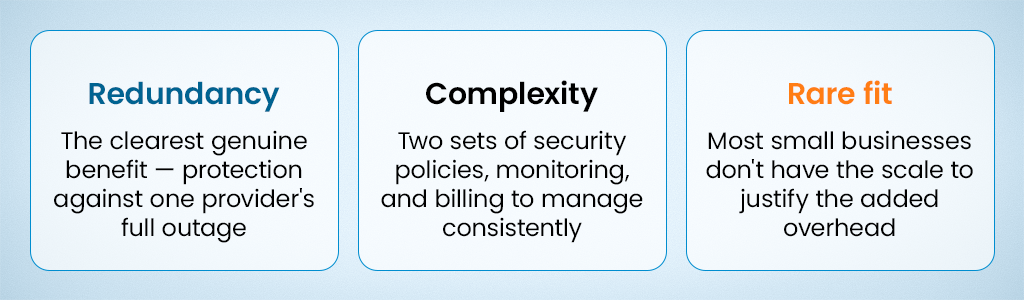
Multi-cloud means deliberately running workloads across more than one cloud provider (AWS and Azure simultaneously, for example) rather than standardizing on one. It’s a legitimate architecture for specific reasons: avoiding vendor lock-in, leveraging one provider’s particular strength for a specific workload, or genuine redundancy against an entire provider’s outage. For most small businesses, though, the operational cost of running two environments outweighs those benefits. If you’re unsure where your business stands, our cloud services team can review your setup.
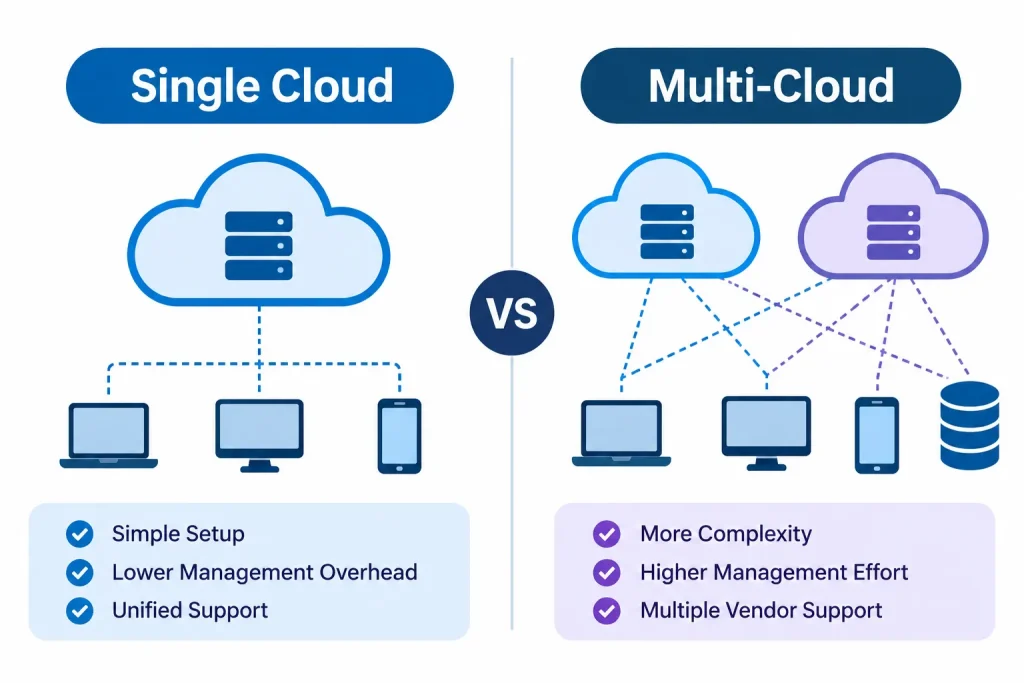
Multi-cloud for small business compared with a single cloud setup
The Honest Tradeoff in Multi-Cloud for Small Business
Multi-cloud for small business is justified only in a few specific situations:
Factor
Single cloud
Multi-cloud
Operational complexity
One set of tools, policies, and expertise to maintain
Two of everything — genuinely more to manage consistently
Outage protection
Vulnerable to that provider’s full-platform outages
A full outage of one provider doesn’t take down everything
Vendor negotiating leverage
Limited — fully dependent on one provider’s pricing and terms
Some leverage from not being fully locked into one vendor
Staff/provider expertise required
Deep expertise in one platform is achievable for a small team
Requires genuine competence across two different platforms
Cost efficiency
Easier to optimize and monitor spend on a single bill
Harder to track and optimize spend split across two providers
“Multi-cloud” often really means “multiple SaaS tools on different clouds” — that’s not the same thing
A business using Microsoft 365 alongside a website hosted on AWS isn’t practicing multi-cloud architecture in the meaningful sense — those are separate, independent services, not a deliberately distributed workload with redundancy or failover between them. True multi-cloud involves actively architecting a single system to run across providers, which is a bigger commitment than simply using different SaaS tools that happen to run on different infrastructure.
A managed IT services partner can help you tell the difference before you spend money on the wrong thing.
When multi-cloud genuinely makes sense
Genuine uptime requirements that a single provider can’t guarantee alone: If even a rare full-platform outage would cause serious business harm, redundancy across providers becomes a real consideration — this is uncommon for most small businesses but real for some.
Specific workloads that genuinely benefit from different providers’ strengths: Some businesses use one provider for its specific AI/ML tools and another for cost-effective standard hosting — a deliberate technical decision, not a general redundancy strategy.
Regulatory or contractual requirements specifying vendor diversity: Uncommon for small businesses, but some industries or specific client contracts genuinely require this.
What most small businesses should do instead
A more realistic approach to multi-cloud for small business is to build depth on one platform first:
Standardize on one cloud provider and build genuine expertise there. If your internal team is small, co-managed IT can fill the skill gaps.
Use that provider’s built-in redundancy features (multi-region deployment) rather than a second provider entirely.
Keep backups genuinely separate from the primary environment, even if that means a second provider for backup storage specifically. See our cloud backup and disaster recovery services for how this works in practice.
Revisit the multi-cloud question only if a specific, concrete need emerges — not as a default architecture.
In short, multi-cloud for small business should be a deliberate decision, not a starting point.
It’s a lighter, more targeted version of the same redundancy principle — and generally a good practice — without the full operational overhead of running production workloads across two providers simultaneously.
Sometimes at larger scale, but the administrative overhead of managing two environments often outweighs any pricing leverage gained for a small business — this benefit tends to materialize more clearly at enterprise scale. For multi-cloud for small business, the savings rarely justify the extra management work.
Not in the architectural sense — using separate SaaS tools that happen to run on different infrastructure isn’t the same as deliberately distributing one system’s workload across providers for redundancy or optimization.
Conclusion and Next Steps
Multi-cloud is a legitimate architecture for the right situation, but “the right situation” is genuinely less common for small businesses than marketing material often suggests. Standardizing on one provider and using its built-in redundancy features covers most small business needs without the doubled operational burden. Not sure which path fits you? Talk to our IT team and we’ll help you decide.