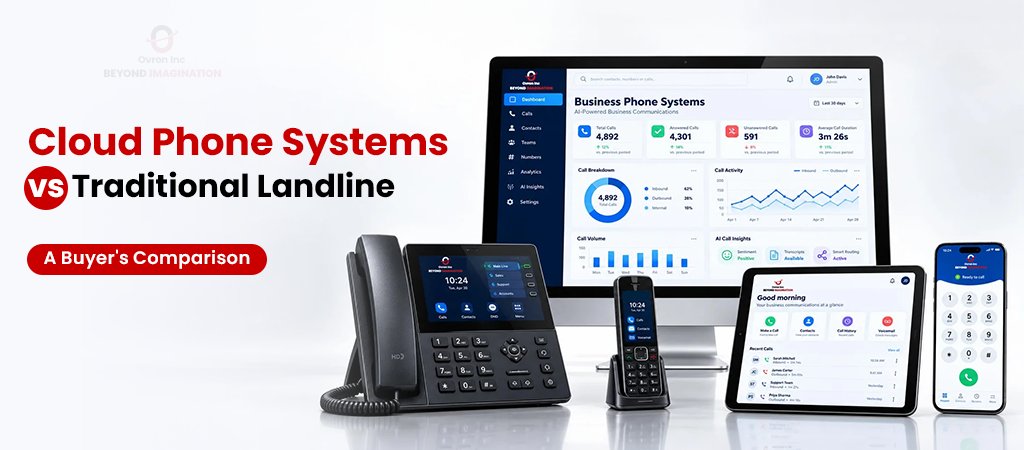
Earlier this month we looked at the technical considerations when choosing VoIP between Cloud Phone Systems vs Traditional Landline. This gives you a more direct comparison with a look at the feature set, cost structure and terms of service.
This article compares the pros and cons of moving from a landline to VoIP. If you want to see the technical differences between a Cloud VoIP phone services and landline then please refer to our article from September which talks about these issues. However, this is a more practical look at what you get for your money and what you can expect from your contract.
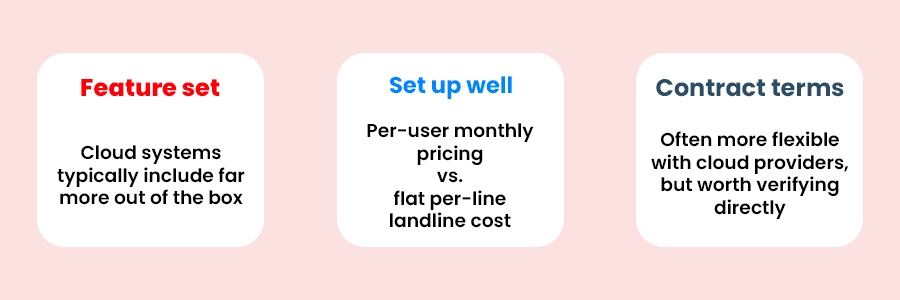
feature set Pricing model Contract terms
Feature comparison Between Cloud Phone Systems vs Traditional Landline.
Feature
Traditional landline
Cloud phone system
Auto-attendant / call routing
Often a costly add-on, if available at all
Typically included in standard plans
Voicemail-to-email/transcription
Rarely available
Commonly included
Mobile app / remote calling
Not available — tied to physical location
Standard on most business plans
Call analytics and reporting
Limited or unavailable
Often included, with varying levels of detail by plan
Conference calling
Often a separate add-on cost
Frequently included in standard plans
Pricing structure for Traditional Landline vs VoIP
1. Traditional Landline: flat per-line monthly cost
Predictable yet scales linearly. Adding more lines will always increase the cost in a proportional way. In addition there will be installation fees, for each physical line
2. Cloud system pricing: typically per-user monthly pricing, tiered by feature set
The costs per line can often be much lower. You can also choose to pay for the level of features that you need and won’t incur any extra charges for features you don’t need.
3.Installation and equipment costs
Setting up landlines can be costly for new lines. Cloude for Businesses usually involve less physical infrastructure. However, if you do want to use desk phones there is an additional charge.
Compare the total cost at your actual line count, not a per-line headline number
Per line rates can be misleading on a small scale due to per tiers and minimum users that some Cloud VoIP phone services providers will have. It’s always best to get a real quote for the number of lines you need.
Contract terms worth checking
Contract questions to ask either type of provider
What’s the minimum contract length, and what’s the early termination cost?
Are number porting and setup fees included, or billed separately?
What happens to pricing after an initial promotional period, if one applies?
Is emergency (911) service included and correctly configured, particularly for cloud systems?
Yes, it is very common to have a mix of both. If you have some offices that have good landlines and others moving to Cloud then it can be a hybrid solution.
This will depend greatly from one service provider to another — it would be appropriate to consider the quality of support as a factor in itself rather than assuming that either one is superior to the other in general terms.
Cloud telephony typically offers scalable, usage based charges, based around a monthly rate per user, whereas landline services typically offer a flat-rate per line. Depending on your user requirements, installation and contract charges, cloud telephony could be cheaper for small businesses.
Generally cloud phone systems are charged at a monthly rate with various features available. Traditional landlines are generally charged a set monthly rate. Depending on your users needs, set up costs and contract, a cloud solution may be more cost effective for small businesses.
Conclusion and Next Steps
Richness of features and flexibility in pricing usually make the cloud-based system preferable between Cloud Phone Systems vs Traditional Landline for most small firms today, but that does not mean that the right decision always depends on your particular number of lines, terms of contract, and willingness to accept internet dependency discussed in the VoIP article. Talk to our IT team and we’ll walk through it with you.