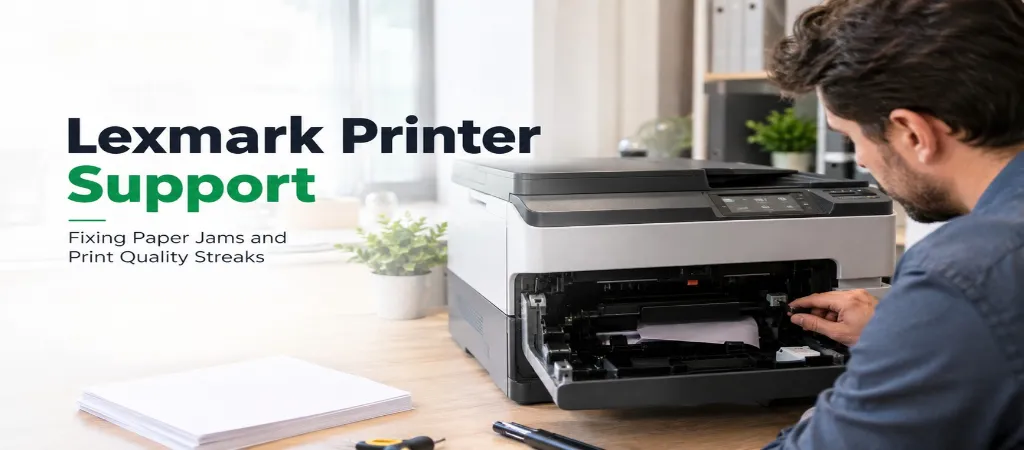
Lexmark’s business printers handle real office volume well, but two issues generate most service calls: recurring paper jams and vertical streaking. Both usually trace back to a specific, fixable cause rather than a failing machine.
Lexmark printers are a common choice for offices needing reliable, higher-volume printing, and most of what generates a service call falls into one of two categories: the printer keeps jamming, or output has developed vertical streaks. Neither is usually a sign the printer is failing — both have specific, checkable causes.
Vertical streaking: why it's usually not the cartridge
The instinct when print quality degrades is to replace the toner cartridge, but persistent vertical streaks are more often caused by a dirty or worn transfer roller, which physically transfers toner onto the page. A contaminated roller leaves a consistent streak at the same position on every page. Cleaning it (following the specific process for your model) resolves this far more often than a cartridge swap does.
Recurring paper jams: what to actually check
Likely cause
What to check
Paper quality or condition
Humidity-affected or low-quality paper jams more often — try a fresh ream from a sealed package
Overfilled paper tray
Paper loaded above the fill line can cause misfeeds — check the tray’s marked maximum
Worn feed rollers
Rollers lose grip over time and high page counts — a common cause on older or high-volume units
Torn paper fragments left behind
After clearing a jam, small torn pieces can remain and cause the next one — inspect the full paper path carefully
Incorrect paper size/type setting
A mismatch between the tray setting and actual loaded paper causes feed errors
KEY INSIGHT
Check the full paper path after every jam, not just the
visiblespot
It’s common to clear the visible jam and assume the problem is solved, while a small torn corner remains further along the paper path — causing the “same” jam to recur almost immediately. A full inspection after clearing takes an extra minute and prevents a repeat call.
Step-by-step: cleaning the transfer roller
Power off and unplug the printer: Safety first — the roller area involves internal components that shouldn’t be accessed while powered.
Locate the transfer roller per your model’s manual: Location varies by model — check Lexmark’s documentation for your specific printer rather than guessing.
Clean gently with a lint-free cloth:Avoid liquid cleaners unless specifically recommended for your model — dry or lightly damp cleaning is usually sufficient.
Reassemble and print a test page: Compare against the streaking you saw before — if it’s resolved, you’re done; if not, it may be a worn roller needing replacement.
When to call for service instead
Streaking persists after cleaning the transfer roller.
Jams recur multiple times daily despite checking the full paper path.
Feed rollers show visible wear or damage.
The printer displays a hardware error code that doesn’t clear.
A consistent streak at the same horizontal position on every page points to the roller. Random or inconsistent streaking is more likely toner-related. When in doubt, try cleaning the roller first since it’s the more common cause.
Yes, more than people expect — lower-quality or humidity-exposed paper jams noticeably more often. If jams are frequent, switching to a fresh ream of quality paper is a cheap first test.
This depends heavily on print volume rather than time elapsed — high-volume offices may need replacement more often than the calendar alone would suggest. If jams increase gradually over time despite good paper and clean paths, worn rollers are a likely cause.
Conclusion
Between checking the paper path thoroughly and knowing to clean the transfer roller before replacing toner, most Lexmark service calls are either avoidable or resolvable without a technician — worth trying both before assuming the machine needs professional attention.