You don’t have to choose between “hire more IT staff” and “let the team keep drowning in tickets.” Co-managed IT fills the gap between the two — here’s exactly how the model works, how responsibilities get split, and when it makes more sense than either full outsourcing or hiring.
A common misconception is that co-managed IT is just managed IT with extra steps, or a way for an outside provider to slowly take over a company’s IT department. In practice, it’s a distinct model built specifically for businesses that already have internal IT capability — usually one or two people — but not enough capacity or specialized coverage for everything the role requires.
What co-managed IT actually looks like day to day
The specific split varies by agreement, but a common pattern: internal IT staff handle daily, hands-on tasks (user support, day-to-day troubleshooting, hardware setup) since they’re on-site and know the business. The external co-managed partner handles after-hours monitoring, specialized security work, backup management, and overflow capacity during busy periods — the things a single internal person often can’t cover alone without burning out.
How responsibilities typically get divided
Responsibility
Typically internal IT
Typically co-managed partner
Day-to-day user support
Limited to business hours
Primary owner
Security & compliance
Awareness/reporting
Primary owner
Strategic IT planning
Primary owner, with input
Advisory/technical input
Backup & disaster recovery
Oversight
Primary owner, including testing
KEY INSIGHT
The exact split is
negotiated, not fixed
This division isn’t a rigid template — a good co-managed relationship starts with an honest conversation about what internal IT already handles well and where the real gaps are, then structures the agreement around that specific business’s needs.
Signs co-managed IT is worth exploring
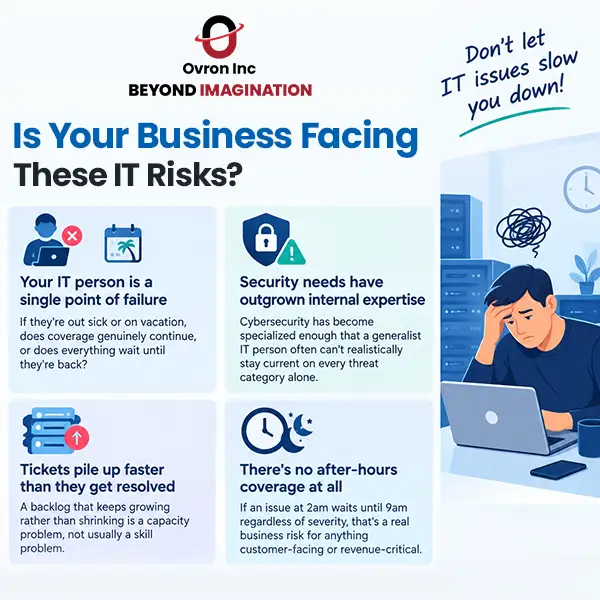
Your IT person is a single point of failure: If they’re out sick or on vacation, does coverage genuinely continue, or does everything wait until they’re back?
Security needs have outgrown internal expertise: Cybersecurity has become specialized enough that a generalist IT person often can’t realistically stay current on every threat category alone.
Tickets pile up faster than they get resolved:A backlog that keeps growing rather than shrinking is a capacity problem, not usually a skill problem.
There’s no after-hours coverage at all: If an issue at 2am waits until 9am regardless of severity, that’s a real business risk for anything customer-facing or revenue-critical.
Questions to ask when evaluating a co-managed partner
How exactly will responsibilities be divided, in writing?
Who has final decision authority on IT strategy — internal staff or the partner?
How does the partner communicate and coordinate with internal IT day to day?
What happens if internal IT staff turns over — does coverage continue seamlessly?
Often less expensive than hiring a second full-time IT employee, since it typically costs less than a salary while still adding meaningful coverage — though the specific comparison depends on your business’s size and needs.
This is a legitimate concern worth addressing directly — a well-structured co-managed relationship is explicitly designed to support internal staff, not diminish their role, and framing that clearly from the start matters.
Yes — co-managed agreements are typically flexible enough to shift the division of responsibilities as internal capacity or business needs evolve, rather than being fixed permanently at signing.
Conclusion
Co-managed IT works best when it’s framed honestly from the start — as genuine support for an internal team that’s stretched thin, not a slow transition toward full outsourcing. Businesses that get the most value from it tend to be the ones with a clear, written understanding of who owns what from day one.