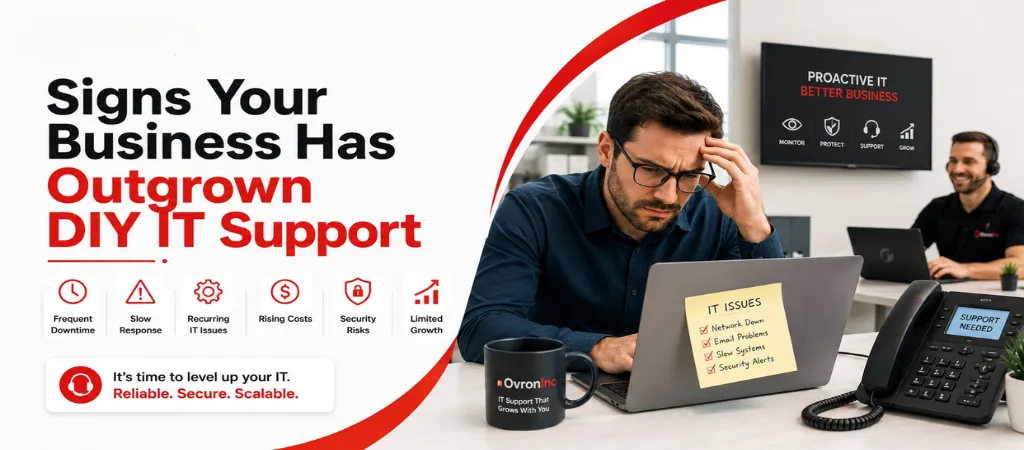
Almost every small business starts the same way: an owner who’s “good with computers,” or one employee who quietly becomes the unofficial IT person on top of their actual job. It works — until it doesn’t. Somewhere between 10 and 50 employees, most businesses hit a point where informal, in-house IT can no longer keep up with the number of devices, the sensitivity of the data, or the cost of downtime. This guide walks through the clearest warning signs that your business has outgrown DIY IT support, and what a managed IT services model actually replaces.
Why Businesses Start With DIY IT — and Why It Doesn't Scale
DIY IT makes sense at five employees and one shared laptop policy. It stops making sense once you have multiple locations, remote staff, client data subject to compliance rules, or software critical enough that an hour of downtime costs real money. The problem isn’t that DIY IT is a bad idea — it’s that it was never designed to scale past a certain size, and most businesses don’t notice they’ve crossed that line until something breaks.
Sign #1: One Person Is Now Your Entire "IT Department"
If a single employee — often someone hired for a completely different role — is the only person who knows how your network is configured, where backups live, and which vendor to call, your business has a single point of failure. If that person is out sick, on vacation, or leaves the company, IT knowledge often leaves with them. A managed IT provider replaces one person’s tribal knowledge with a documented, team-based support structure.
Sign #2: You Don't Know What You Don't Know About Security
Basic antivirus software is no longer considered adequate protection for a business handling client data, financial records, or health information. If your business doesn’t have endpoint detection and response (EDR), multi-factor authentication enforced company-wide, and a documented incident response plan, you likely have blind spots you’re not aware of — which is itself one of the clearest signs it’s time for a managed IT partner to run a real security assessment.
Sign #3: Backups Exist, But No One's Tested Them
Many small businesses have backups running somewhere — an external drive, a cloud folder, a legacy system nobody’s touched in years. Far fewer have ever actually tested restoring from that backup. An untested backup is not a real backup; it’s an assumption. Managed IT and backup & disaster recovery services build in regular restore testing specifically because “we have backups” and “we can actually recover” are two very different claims.
Sign #4: IT Issues Are Always Reactive, Never Prevented
If every IT interaction in your business starts with something already broken — a frozen computer, a printer that stopped responding, a server that’s suddenly slow — you’re operating in a purely reactive model. Managed IT services shift this to proactive monitoring, catching failing hard drives, expiring certificates, and unusual network activity before they cause an outage.
Sign #5: Software and Licenses Are a Mess
As businesses grow, software licenses accumulate — some paid for and forgotten, some shared across more users than the license allows, some critically out of date. Without centralized IT management, most SMBs lose track of what’s actually installed, what’s licensed correctly, and what’s running unpatched, outdated software that’s a known security risk.
Sign #6: You've Had a Close Call (or a Real Incident)
A near-miss — a phishing email that almost got clicked, a ransomware pop-up caught in time, a laptop that was nearly lost with unencrypted client files — is often the moment businesses realize DIY IT has run out of runway. If your business has had any kind of security scare in the past year, that’s a strong signal, not a coincidence to shrug off.
Sign #7: Growth Is Being Slowed by Tech, Not Enabled by It
Onboarding a new employee should take an hour, not three days of scrambling to set up accounts, hardware, and permissions. If your business’s growth is regularly bottlenecked by “we need to figure out the tech side first,” that’s a direct cost of outgrown IT infrastructure — and one of the fastest returns on switching to managed IT.
Sign #8: Compliance Requirements Are Creeping In
Law firms, healthcare clinics, accounting firms, and insurance agencies increasingly face compliance expectations (HIPAA, client confidentiality obligations, cyber-insurance requirements) that DIY IT setups were never built to satisfy. If a cyber-insurance renewal, a client contract, or an industry regulator has started asking questions about your security posture, that’s an external signal your IT needs to formalize.
Sign #9: You Can't Put a Number on Your IT Risk
If you were asked right now how long your business could operate without email, your shared files, or your line-of-business software, could you answer confidently? Most DIY-IT businesses can’t — because no one has ever mapped out recovery time objectives or tested what failure actually looks like. Managed IT providers typically start every new client relationship with exactly this kind of risk assessment.
What Managed IT Services Actually Replace
A managed IT services agreement typically consolidates:
Help desk support (replacing the “ask whoever’s good with computers” model)
Network monitoring and maintenance
Cybersecurity tools and policy (EDR, MFA, awareness training)
Data backup and disaster recovery, with tested restores
Microsoft 365 or Google Workspace administration
Server management and cloud migration support
Compliance support and documentation
Current industry pricing guides put this bundled scope at roughly $100–$250 per user per month for small businesses, scaling toward $200–$300+ for compliance-heavy environments like healthcare or legal services — often less than the fully-loaded cost of a single in-house IT hire, while providing a full team instead of one person.
How Ovron Inc Helps Businesses Make the Switch
Ovron Inc’smanaged IT serviceswork specifically with the businesses that are outgrowing informal IT: law firms, healthcare clinics, accounting firms, schools, nonprofits, and retail and corporate offices. Our plans are delivered under written agreements with clear response-time commitments, covering help desk, network monitoring, cybersecurity, backup and disaster recovery, Microsoft 365 administration, and compliance support — with no vague, undocumented promises.
There’s no single employee-count trigger, but most businesses feel the strain somewhere between 10 and 50 employees, or as soon as they handle sensitive client data, operate across multiple locations, or face compliance requirements.
For most businesses under 75 employees, managed IT services are typically less expensive than a full-time in-house IT hire once salary, benefits, and single-person coverage limitations are factored in, while providing broader expertise.
Most providers begin with a network and security assessment to document your current environment, identify immediate risks, and establish backup and recovery testing before formalizing an ongoing support plan.
Yes. Many businesses keep an internal point of contact for day-to-day coordination while a managed IT provider handles monitoring, cybersecurity, backups, and after-hours coverage — a hybrid model that’s increasingly common.
Need Professional Printer Help?
Whether you need printer setup, wireless configuration, print quality troubleshooting, or expert repair, the OvronInc team is here to help homes and businesses across the United States.
If more than two or three of the signs above sound familiar, your business likely isn’t failing at IT — it’s simply outgrown the informal approach that worked when the company was smaller. The good news is that the transition to managed IT services is usually far less disruptive than business owners expect.
Not sure if you’ve outgrown DIY IT?Talk to an IT Expertat Ovron Inc for a free assessment of your current setup and where the gaps are.