Our experience is that many of our potential clients have a similar set of questions, especially early in their business development process. One of those questions is, “how long will it take you to build our app?”. As a service provider, we appreciate the desire to understand the timing of a project; however, answering with “it depends” often feels unsatisfying. With this post, we’ll describe what we feel is a realistic app development timeline for a custom software development project, and give the business owner a framework to understand what is going on with a software project and identify if a project is going off-track — insight drawn from our experience as an app development company.
Why is There So Much Variability in Project Estimates?
The reason a project timeline has a low and high bound is related to the type and complexity of the software being built. For instance, an app that needs to process client payments and manage access levels for multiple types of users will be more complex and take longer to build than a simple web app to help manage a project team. The 5 week to 12 week timeline is broadly applicable to the types of software projects a small to mid-size business would consider building. Longer, more complex software projects, for example a custom enterprise resource planning (ERP) system, would take longer to build.
What is Covered in the 5 Week to 12 Week Range?
A software project can be scoped to take 5 weeks if the project is straightforward and does not require a lot of integration, and the development team has previous experience with similar software projects. More complex projects, and/or projects that require a development team to work with a client to understand a business more before software design and architecture can be scoped to take 12 weeks. Projects with less well-defined software requirements and specifications would take longer to develop than more precisely scoped projects a key reason app development cost timeline estimates vary so widely between projects.
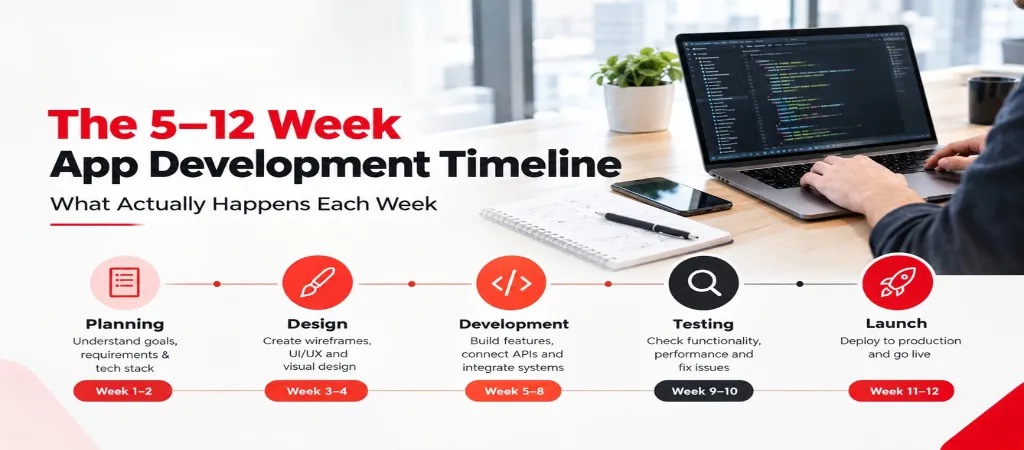
Weeks 1-2: Discovery and Planning
The Discovery phase helps create a realistic scope for the app. It also identifies all major features and clarifies the limitations for this version of the app — often the starting point for an MVP development timeline. Defining features and limitations helps create a realistic timeline for development. A clear scope helps provide a realistic estimate for the overall cost of the app. This up-front cost helps create a realistic budget.
Weeks 2-4: Design and Prototyping
In this phase, the design team creates a series of computer generated images of app screens and app flows, as part of the broader app design process. These designs are based on the features and functions defined in the previous phase. During this phase, clients have the opportunity to review and provide feedback on designs. For this version of the app, a prototype helps clients simulate intended app flows and functions. A prototype helps point out potential design issues and usability issues and provides clients the opportunity to review and evaluate the app before the coding phase.
For a related comparison of build approaches, see our WordPress vs Custom Website guide, which covers similar custom-build vs. platform tradeoffs.
Weeks 4-9: Core Application Development
This is the longest phase of the overall process. It includes the design and development of major app components, features and functions. Like the overall development process, this phase is also subdivided into smaller time frames and milestones — one of the core custom app development stages in the broader mobile app development process.
Weeks 9-11: Testing and Improvement
Test your app and see if your features function properly. Also, see if your app can be used on different devices and browsers. Often, when testing a mobile app, you want to see if the app can be used on different operating systems and models. The final type of testing is known as user acceptance testing. This type of testing allows your clients to test your app and see if it meets their requirements — a critical part of the app testing phase.
Weeks 11-12: Final Preparations and Release
After testing is completed, your app can be placed on mobile devices. If changes need to be made to the app after it is placed on the mobile device, the changes will need to be made by your app store. Also, your servers need to be ready to support the app. Your employees need to learn how to use the app if it is going to be used internally. How will your app be supported after launch? How will bug fixes and enhancement be made? Your employees need to learn how to perform these tasks. Plan for these support requests and determine how long the support requests will take — all part of a complete app launch checklist.
What Extends a Timeline Beyond 12 Weeks?
Complex third-party integrations (payment processing, industry-specific software, existing legacy systems) that require additional discovery and testing time
Scope changes mid-project — adding features after development has begun almost always extends the timeline, since new features need their own design, development, and testing cycles
App store review delays for mobile apps, which are outside the development team’s control and can add days to weeks depending on the platform
Multiple user roles and complex permission structures, which add testing complexity beyond a simple single-user application
What Helps Maintain Project Time-Lines?
The development time-line is greatly affected by the feedback process. Clients who take too long to give feedback or who provide feedback at the very end of a time-line negatively affect the development time-line. scope (changes to the project requirements) negatively impacts the development time-line. A development partner should communicate the impact of project scope changes — a discipline built into a healthy software development lifecycle.
How does Ovron Inc. Structure App Development?
All custom app development projects at Ovron Inc. are structured. The project structure and client communication helps prevent surprise scope changes and project delays, reflecting how a dependable app development company operates.
We develop a lot of small-to-mid-sized business applications, and our average timeline is between 5 and 12 weeks. Some aspects of a project that can extend or reduce that timeframe are the number of integrations, the number of features, and the clarity of the project scope.
Scope creep is one of the biggest causes of delays during development. Other delays can come from integrations that appear simple but have hidden complexity and finally delays that are out of your control like app store reviews for mobile applications.
Yes, mobile app development is different from other kinds of software development because the review process for mobile apps takes a relatively long time and is out of the development team’s control. Therefore, you should plan for this extended period when thinking about your launch date.
Summary and Next Steps
There are different phases in mobile app development and understanding the average work pace for each phase helps clients identify lags in work. The app development companies that work efficiently and effectively are the ones that have clear app development plans and focus.
Do you want to create a mobile app? Ovron Inc can provide an estimate of what it will cost and how long it will take.